Approach
Interview, diagnose, then make it concrete
Interviews
Service design interviews across the markets and functions, establishing how content is produced, how it is governed, and where the existing structure works against the people using it.
This was the engagement where AI became part of how I work rather than something I was trying out. Transcripts went in whole, came back as candidate pain points and opportunity themes, and I reviewed every one against my own notes from the room — keeping what held, cutting what the model had invented or over-weighted, and pushing back on groupings that flattened a real difference between two markets.
From there it became a running log of the top pain points and opportunities that I could keep adding to as interviews landed, rather than a synthesis exercise that happens once at the end. I also used it to generate candidate ideas against those themes — a way of widening the field quickly, so the options on the table came from the evidence rather than from whoever spoke first in the workshop.
Journey analysis, from both sides
Euroconsumers is not one organisation to a customer. It is Test Achats in Belgium, Altroconsumo in Italy, DECO PROTeste in Portugal and OCU in Spain, each with its own audience and its own way of working, sitting under a group that wants one platform behind them.
So the analysis ran twice over. First the customer journeys — what someone is actually trying to do when they arrive, whether that is choosing a product, getting legal help, or deciding whether membership is worth renewing. Then the Euroconsumers journeys behind them: what the organisation does to serve each of those, which team does it, in which market, and with which system. Setting the two against each other is what makes the gaps visible rather than anecdotal.
Choosing the journeys worth tackling
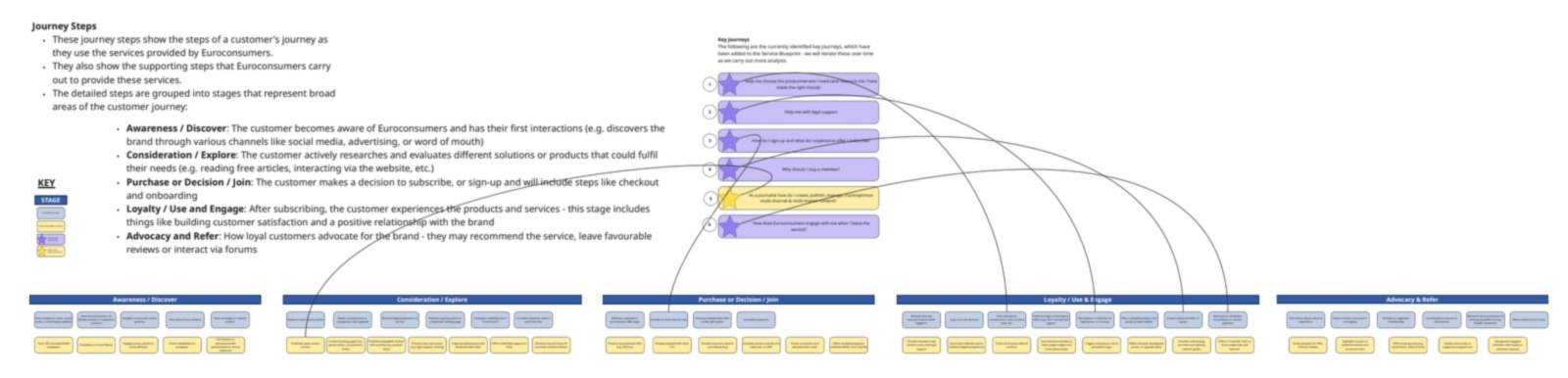
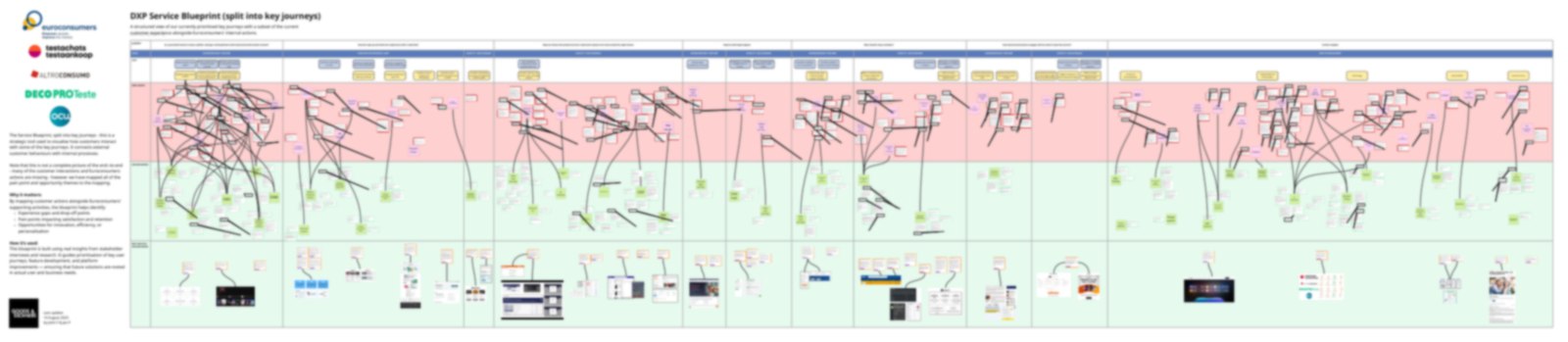
There were more journeys than any roadmap could carry, so the next job was to narrow. Six were selected as the ones that mattered, each written as the question the customer is really asking — help me choose the product I need, help me with legal support, what happens after I sign up, why should I stay a member, and so on — rather than as a feature or a page.
Writing them as questions is deliberate. It keeps the conversation on what the customer wants and away from what the organisation would find convenient to build, and it gives every later decision something to be tested against.
Mapping the key journeys
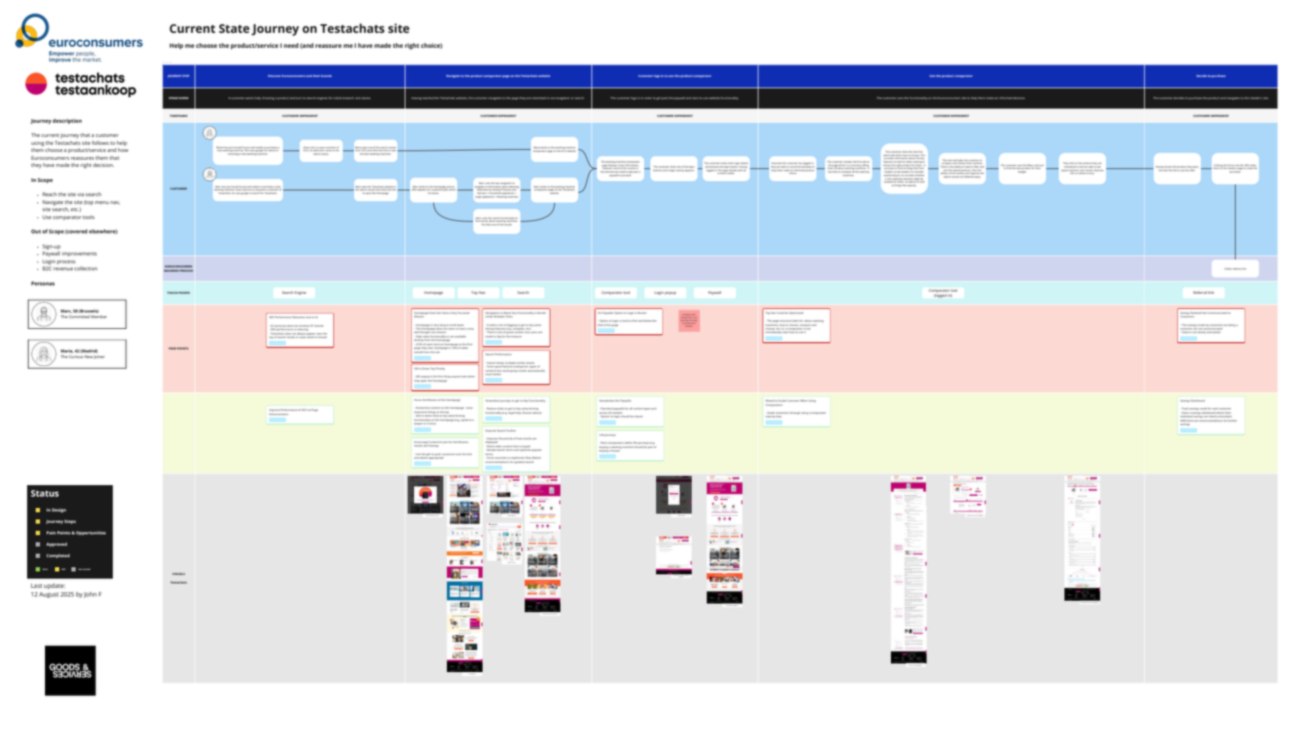
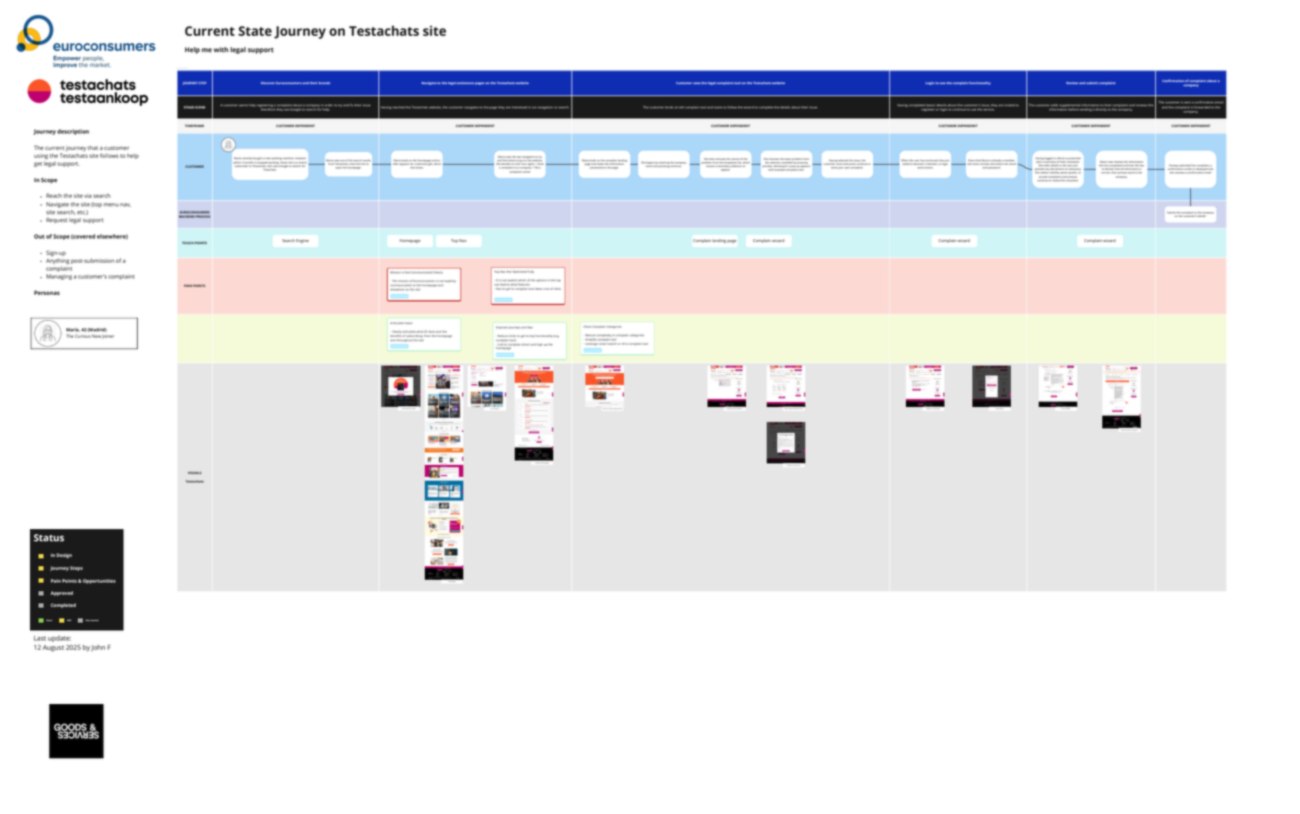
Each of the selected journeys was then mapped in its current state — what the customer does step by step, what Euroconsumers does behind it, the touchpoints and systems involved, and where the path breaks.
The comparator journey and the legal journey are the two that carry the most weight, because they are the two that people join for. Mapping them in detail is what turned a general sense that the experience was fragmented into a specific account of where and why.
The service blueprint
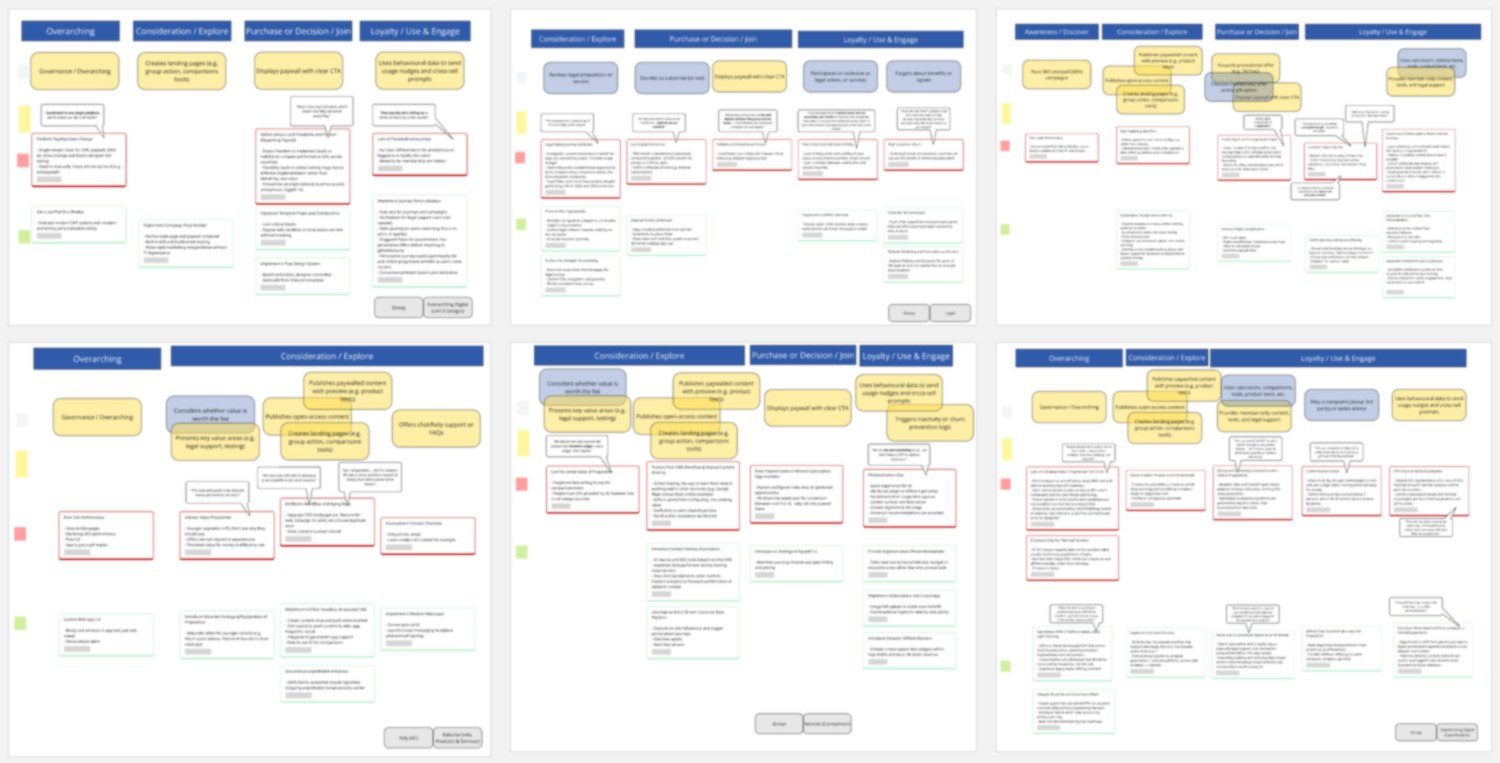
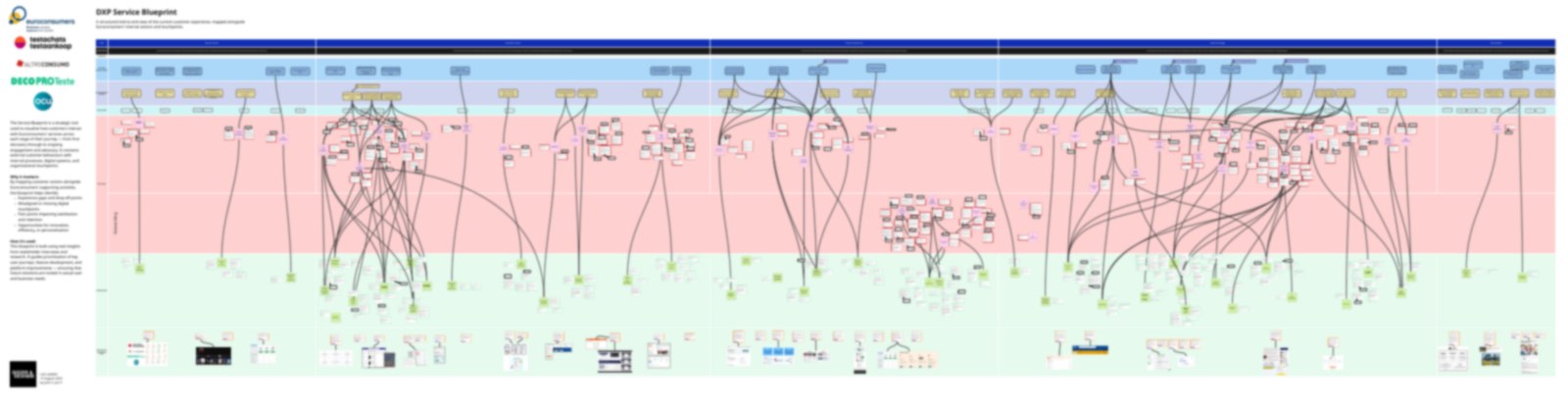
The journey maps were consolidated into a single DXP service blueprint across the five lifecycle stages — Awareness and Discovery, Consideration and Explore, Purchase Decision or Join, Loyalty Use and Engage, and Advocacy and Refer — with the customer steps, the organisation’s steps, the systems underneath, and bands for pain points and opportunities running the full width.
That is the artefact that turns research into a shared picture. Everything after it — the backlog, the initiatives, the requirements — traces back to a theme sitting on the blueprint, which is what stops a roadmap becoming a list of things people happened to ask for.
The North Star Backlog
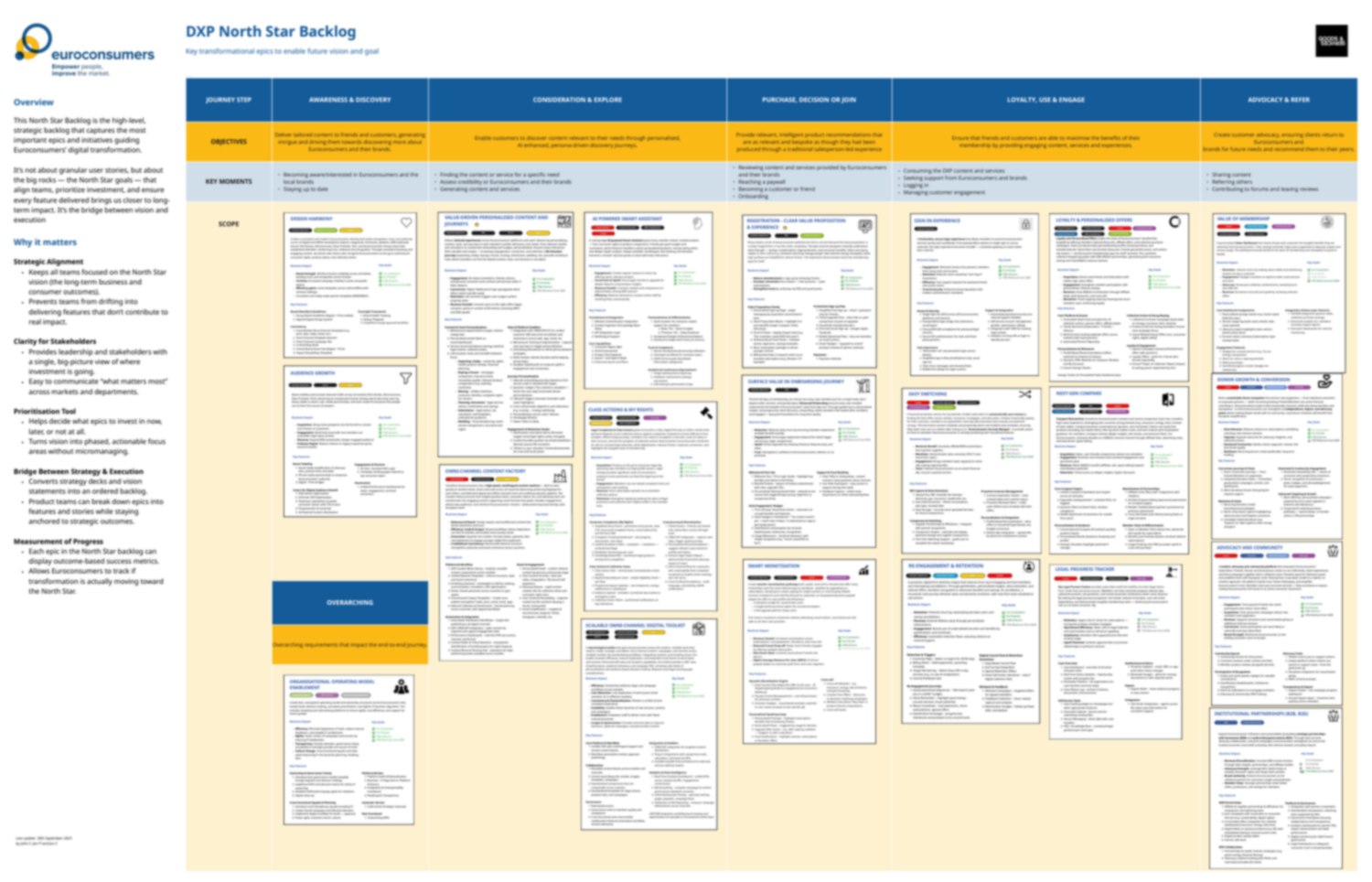
The opportunity themes were grouped into a North Star Backlog: the strategic epics that carry the transformation, arranged against the same five journey stages, with the objectives and key moments for each stage written above them.
It is deliberately not a list of user stories. It sits between the strategy deck and the delivery backlog — big enough that leadership can see the whole picture and decide what to fund, specific enough that a team can pick one up and break it down without having to reinterpret the vision first.
Initiative cards
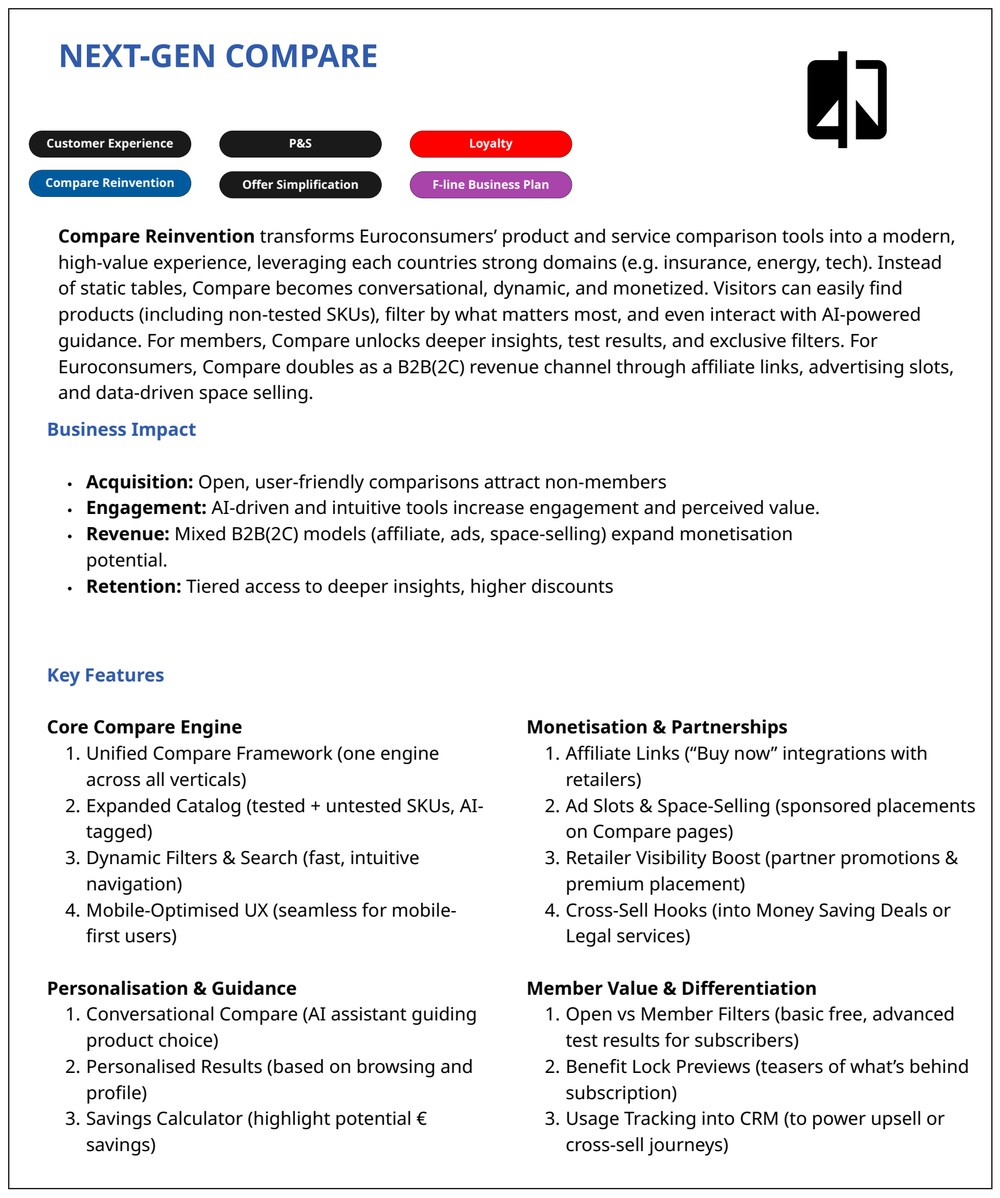
Each epic on the backlog got an initiative card: what it is, the business impact across acquisition, engagement, revenue and retention, the goals it moves, and the features it contains grouped into sub-epics.
The card is what makes an epic arguable. A line on a backlog invites agreement without commitment; a card that states what it will do to revenue and retention, and what would have to be built, forces the conversation about whether it is worth doing before anyone starts doing it.
Wireframes
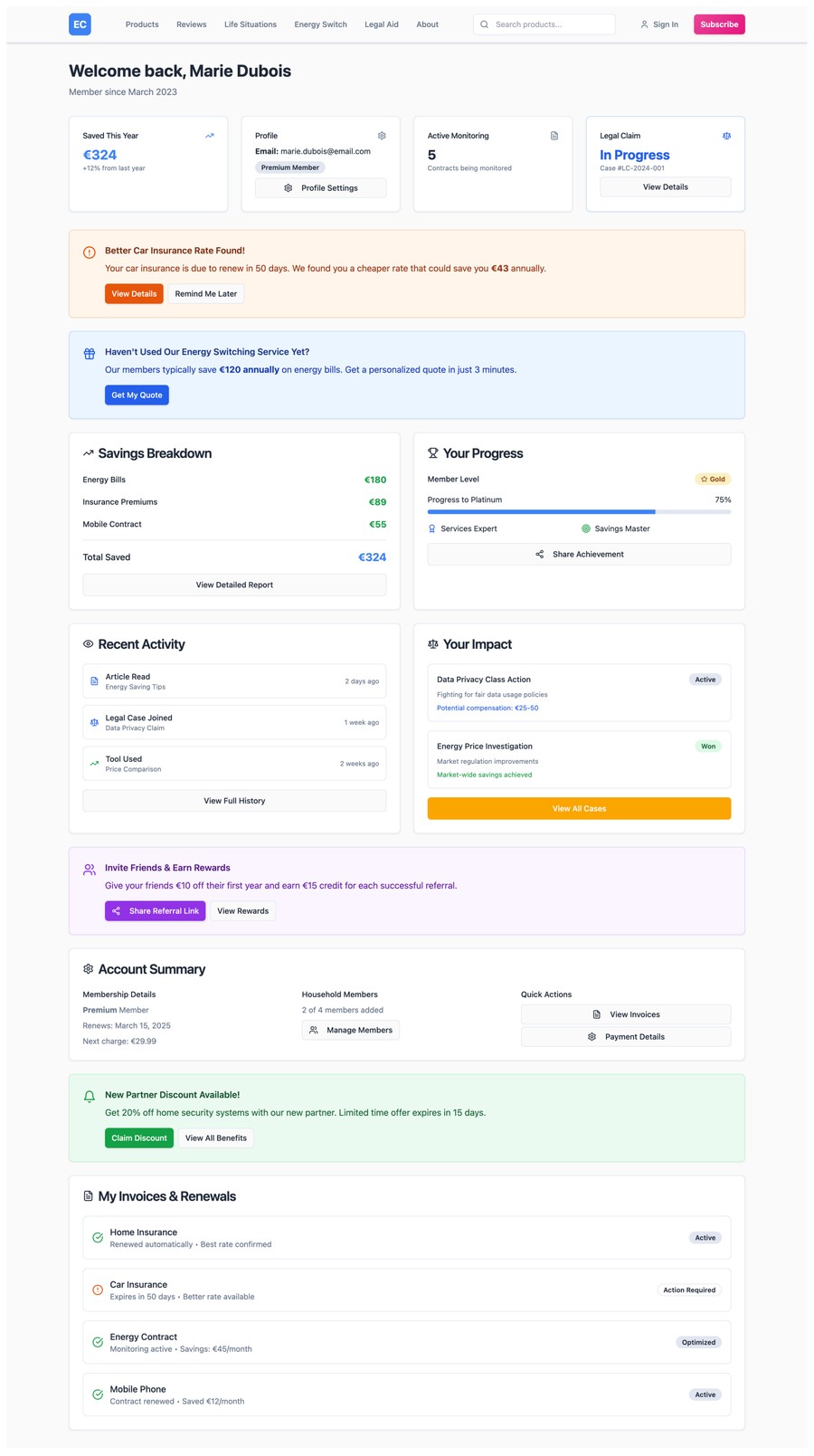
Low-fidelity wireframes were drawn for the journeys where the argument needed to be seen rather than described — the membership value journey in particular, where the whole question is whether someone can tell what they are getting for their subscription.
At this stage in an engagement a wireframe is not a design deliverable. It is a way of testing whether the thinking survives contact with a page, and of giving stakeholders something concrete to react to before the platform decision is locked.
Feature cards
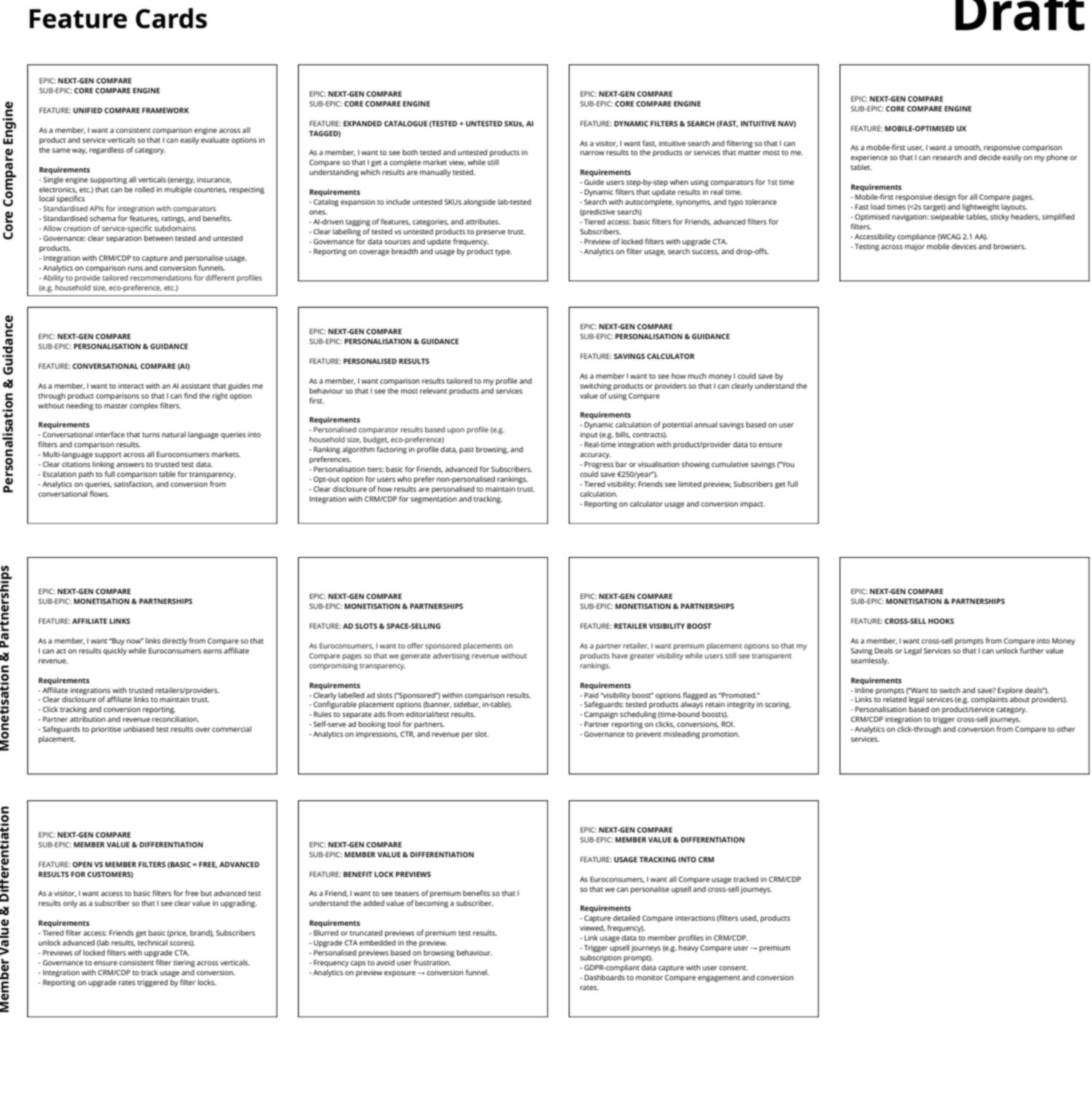
Under each initiative card sit feature cards, one per feature, each tied back to its epic and sub-epic. Every one carries a user story in the standard form — as a member, I want a consistent comparison engine across all product and service verticals, so that I can easily evaluate options in the same way — and the requirements that sit under it.
This is the point where a strategy becomes buildable. The chain runs unbroken from an interview, to a pain point on the blueprint, to an opportunity theme, to an epic on the North Star Backlog, to an initiative with a business case, to a feature with a story and requirements a team can estimate. Anyone can walk that chain in either direction, which is what makes the roadmap defensible when the questions start.